
WEET - Which Audiophiler Crossover Capacitors Unusable?
Have you ever bought MKP crossover capacitor but didn't know how to judge its quality? This article will teach you how to do it.
Practical Listening Test: Verify Performance Through Sound Perception.
Connect the capacitor to a crossover circuit (or build a simple RC crossover test circuit).
High-frequency performance: High-quality MKP capacitors deliver clear, transparent high frequencies with rich details
(e.g., the crisp sound of a triangle is distinctly audible); Inferior capacitors may suffer from severe high-frequency attenuation,
resulting in a dull sound lacking in airiness.Mid-frequency performance: The mid-range of human voices or musical instruments should be naturally full.
Inferior capacitors may cause mid-frequency collapse (thin sound) or distortion (such as blurred or harsh sibilance in vocals).Dynamic response: At high volumes (e.g., in scenarios with drumbeats or symphonies),
high-quality capacitors can maintain a clean, powerful sound without compression;
inferior ones may, due to excessive internal resistance, lead to weak dynamics and a "dispersed" sound.
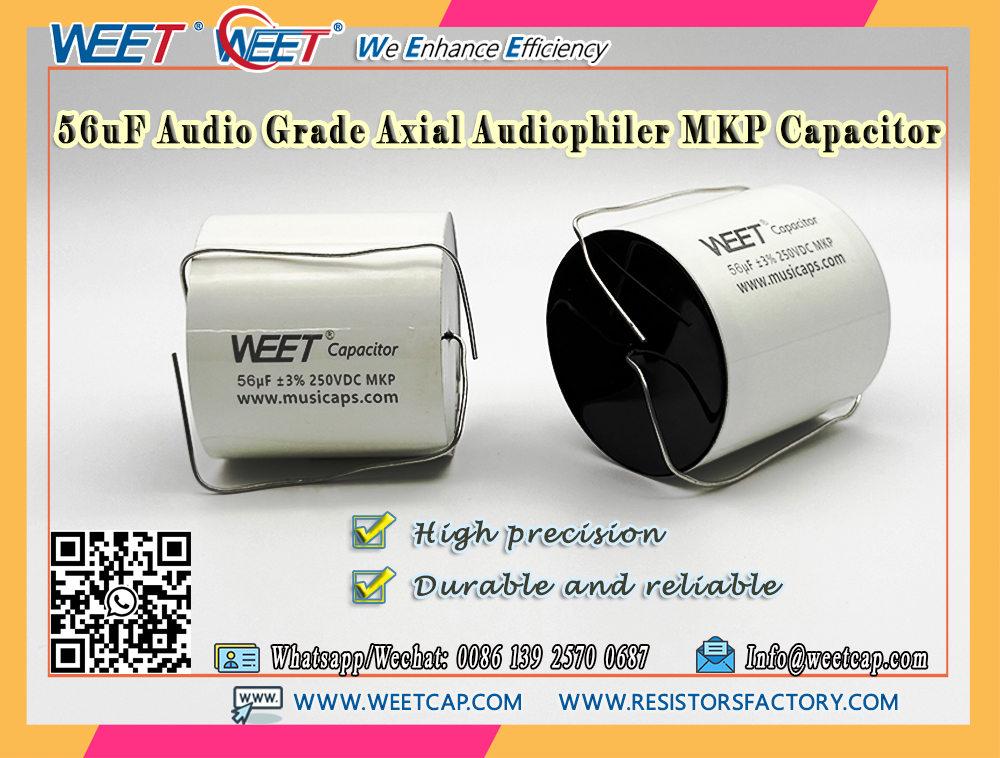
WEET Audio Grade Axial Audiophiler MKP Capacitor, High precision, low loss, durable and reliable. In all aspects, our product has advantages over MCap.
Our axial electrodeless capacitor MKP HIFI crossover can all replace MCap, and the 250V 56uF is a replacement for their MEO-56T3.350.
Contact us:Wallis@weetcap.com
WEE Technology Published on Aug 13, 2025