
What Makes An MMKP82 Capacitor Different From A Conventional Capacitor?
Introduction
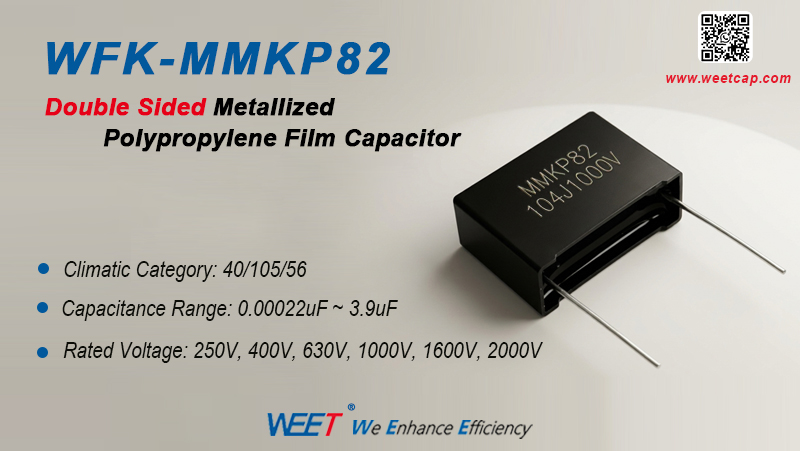
Do you know the difference between an MMKP82 Capacitor and a conventional capacitor?
Before exploring their differences, let's first understand how they are constructed.
MMKP82 Capacitor: Uses double-sided metallized polypropylene (PP) film.
Conventional Capacitor: Typically uses single-sided metallized polypropylene (PP) film.
Now, let's take a closer look at their structural differences.
1. Structural Differences
MMKP82 Capacitor:
The two metallized surfaces participate in the electrode design.
Both sides of the PP film are metallized with a conductive metal layer.
This structure can be combined with other film layers to form a specific capacitor construction.
Conventional Metallized Polypropylene Film Capacitor:
Only one side of the PP film is coated with a metallized layer.
The metallized layer serves as an electrode.
Two layers of metallized film are wound together to form the capacitor element.
2. What Are the Advantages of a Double Sided Metallized Film Capacitor?
So, what advantages does this Double Sided Metallized Film Capacitor structure offer?
Improves reliability in specific applications.
Helps reduce internal losses and heat generation.
Meets the electrical requirements of pulse circuits.
Supports better performance under high-frequency operating conditions.
These structural characteristics make the MMKP82 Capacitor a popular choice for applications requiring reliable high-frequency and pulse performance.
3. Why Choose WEET?
WEET specializes in manufacturing MMKP82 Capacitors and can provide customized solutions to meet different customer requirements.
Are you looking for a reliable MMKP82 Capacitor manufacturer? Contact WEET today to discuss your project!
Contact Whatsapp WEET Products WEET YouTube
WEE Technology Company Limited Published On November 13, 2026